Every business needs a strong digital presence, but choosing the right digital solution can be confusing. Should you build a traditional website to showcase your services, or invest in a web application that allows users to interact with your business online?
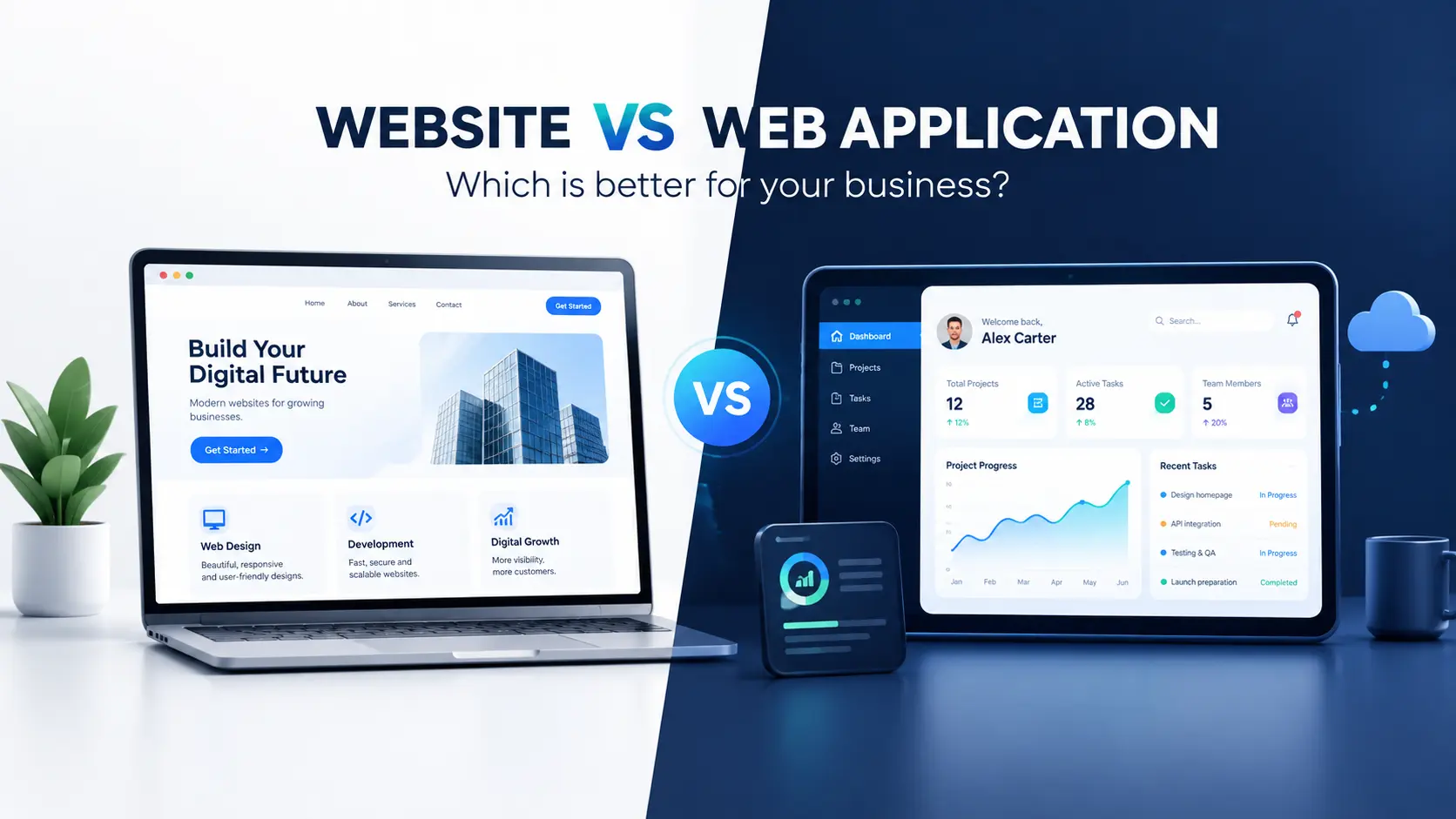
Understanding the difference between a website vs web application can help you make a smarter investment, improve customer experience, and support long-term business growth.
Both solutions operate through web browsers, but they serve different purposes. A website primarily informs visitors about your business, while a web application enables users to perform specific tasks, manage information, and interact with digital services.
In this guide, we will explore the key differences, benefits, costs, and use cases of websites and web applications to help you choose the right solution for your business.
A website is a collection of interconnected web pages accessible through the internet. It helps businesses establish an online presence, communicate with customers, showcase products or services, and generate enquiries.
Most business websites include a homepage, about page, services page, blog, and contact page. Depending on your requirements, you can also include landing pages, portfolios, testimonials, and lead generation forms.
Benefits of a Website
1. Builds online credibility
A professional website helps potential customers understand your business, explore your services, and evaluate your credibility before contacting you.
2. Improves search engine visibility
Search engine optimisation (SEO) helps your website appear in relevant search results. Well-structured pages, useful content, relevant keywords, and good performance can help attract organic traffic.
3. Generates leads and enquiries
Contact forms, calls to action, appointment requests, and WhatsApp buttons make it easier for visitors to connect with your business.
4. Offers a cost-effective starting point
For businesses that primarily need an online presence, a website can be simpler to develop and maintain than a feature-rich web application.
Who Should Choose a Website?
A website is generally suitable for:
-
Small and medium-sized businesses.
-
Digital marketing agencies and professional service providers.
-
Consultants, freelancers, and personal brands.
-
Companies that want to generate leads through Google.
-
Startups validating a business idea before investing in a digital product.
If your primary goal is to promote your business and attract potential customers, explore Builder Monkey’s website to learn more about its digital solutions.
A web application, commonly called a web app, is interactive software that users access through a web browser. Unlike a basic informational website, it allows users to complete tasks, manage data, and receive personalised results.
Web applications typically combine a user interface with application logic, databases, and integrations. Depending on the product, they may also include authentication, role-based permissions, notifications, and payment processing.
Examples of Web Applications
-
Customer relationship management (CRM): Manage leads, customers, and sales activities.
-
Project management platforms: Assign tasks, track deadlines, and collaborate with teams.
-
Online booking systems: Schedule appointments and manage reservations.
-
SaaS platforms: Provide subscription-based software through a browser.
-
Customer portals: Allow customers to access accounts, invoices, documents, and service updates.
Benefits of Web Application Development
1. Automates business processes
A custom web application can reduce repetitive manual work by automating workflows, approvals, reporting, and data management.
2. Provides personalised experiences
Users can log in and access information relevant to their accounts, activities, permissions, or preferences.
3. Improves operational efficiency
A centralised application can help teams manage information in one place instead of switching between spreadsheets and disconnected tools.
4. Supports business scalability
A well-planned application can evolve as your business grows, with additional features, integrations, and user capacity introduced when required.
If you need software tailored to your workflows, explore Builder Monkey’s custom software development services.
Website vs Web Application: Key Differences
Although both use web technologies, their functionality, complexity, and business objectives can differ significantly.
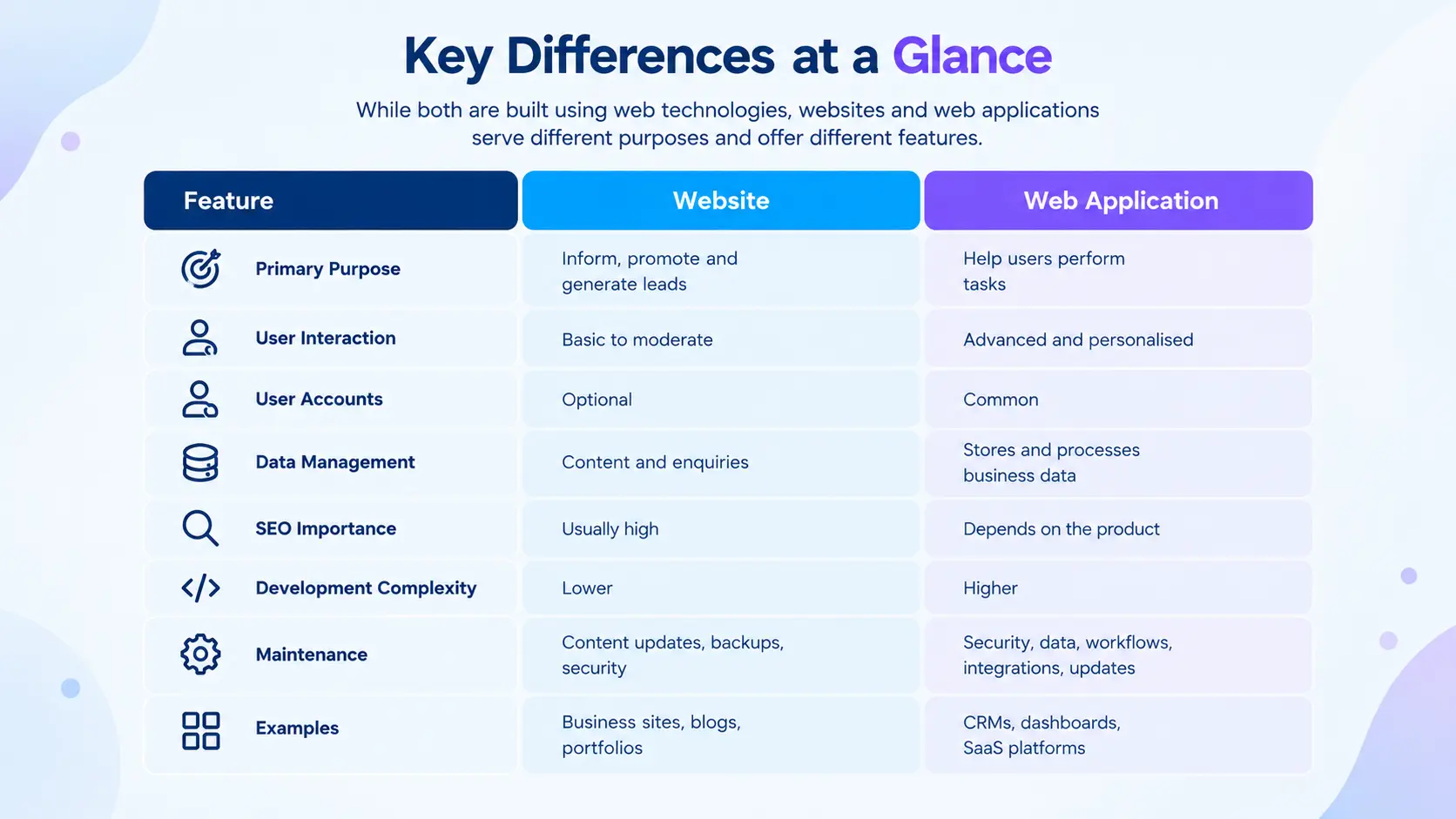
The main difference: A website helps people discover and understand your business, whereas a web application helps them accomplish something through your digital product.
However, the distinction is not always absolute. Modern websites can contain interactive features, and web applications can include public-facing pages designed for search engines.
Website vs Web Application: Which Is Better for Your Business?
The right choice depends on your business objectives, users, and required functionality.
A website is usually the better starting point if you want to:
-
Establish an online presence.
-
Showcase products or services.
-
Rank for relevant keywords on Google.
-
Publish blogs and educational content.
-
Generate enquiries and sales leads.
-
Build trust with potential customers.
For example, a digital marketing agency may need service pages, case studies, a blog, and a contact form. These features can support customer acquisition without requiring a complex custom application.
Choose a Web Application If Your Goal Is Digital Functionality
A web application is more appropriate when users need to interact with a system regularly.
Consider one if you want to:
-
Build a subscription-based software product.
-
Create customer or employee dashboards.
-
Automate internal business operations.
-
Manage bookings, orders, or transactions.
-
Provide personalised user accounts.
-
Connect several business systems through integrations.
For example, a logistics company that wants customers to book shipments, track deliveries, and download invoices may benefit from a web application rather than a basic informational website.
If you are planning a subscription-based product, explore Builder Monkey’s SaaS development services.
Can a Business Have Both a Website and a Web Application?
Yes. In fact, combining both is often an effective strategy for growing businesses.
A public-facing website can attract visitors through SEO, explain your services, and convert potential customers. A connected web application can then provide functionality for registered users.
For example, an online education company might use:
-
Marketing website: Course descriptions, blog articles, instructor profiles, and pricing information.
-
Web application: Student login, course progress, quizzes, certificates, and personalised dashboards.
Similarly, an e-commerce business can use public product pages to attract search traffic while relying on application functionality for shopping carts, checkout, customer accounts, and order tracking.
This approach allows businesses to balance discoverability with functionality.
Website Development vs Web Application Development: What About Cost?
The cost of website development and web application development depends on project scope, design complexity, technology, integrations, security requirements, and ongoing maintenance.
A relatively simple business website generally requires fewer development resources than a custom application with user accounts, databases, automated workflows, and third-party integrations.
Web application projects may also require more extensive testing, access controls, data protection, and long-term technical support.
Instead of comparing prices based only on the labels “website” and “web app,” evaluate the features you actually need.
Before development begins, define your minimum requirements, prioritise essential features, and identify opportunities to use existing tools rather than building everything from scratch.
Startups can also consider a Minimum Viable Product (MVP), which focuses on the core functionality needed to test a product idea before expanding it. Learn more about MVP development services.
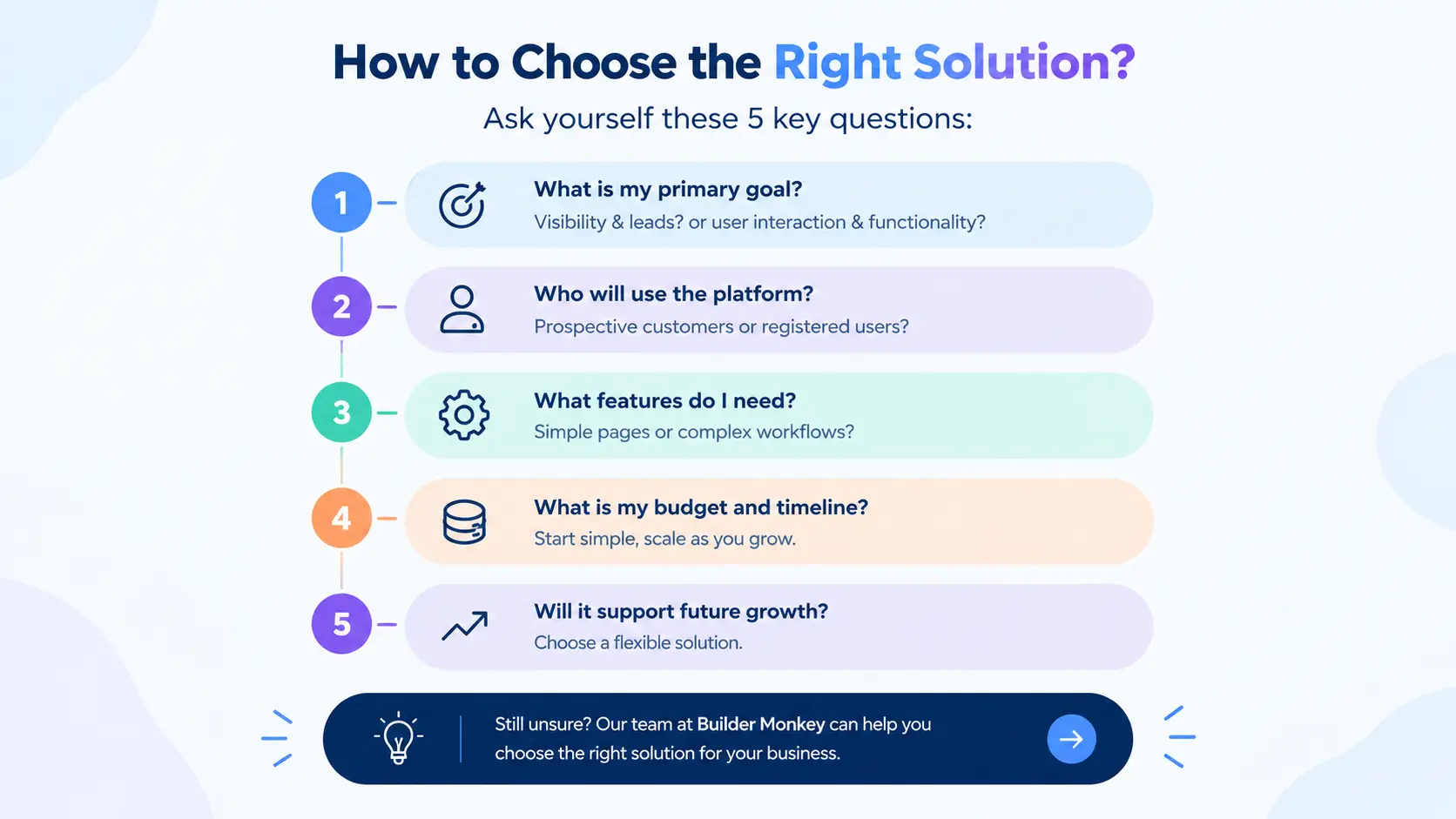
How to Choose the Right Solution: 5 Questions to Ask
Before investing in website development or web application development, answer these five questions:
1. What is my primary business goal?
If you want visibility and enquiries, start with a website. If you need users to complete tasks through software, consider a web application.
2. Who will use the platform?
If most visitors are prospective customers looking for information, a website may be sufficient. If customers or employees need accounts and personalised access, application features may be necessary.
3. What functionality do I actually need?
List your essential features, such as contact forms, payments, dashboards, booking systems, reporting, and integrations. This will help determine the appropriate scope.
4. What is my current budget and timeline?
Start with the simplest solution that meets your immediate requirements. Avoid investing in complex functionality before you have a clear business need.
5. Will the solution support future growth?
Choose an approach that can evolve with your business. You may start with a website and add a customer portal or application features when demand justifies the investment.
For help evaluating technology choices and project requirements, visit Builder Monkey’s software consultation page.
Final Verdict: Website or Web Application?
There is no universal winner in the website vs web application comparison. The best solution is the one that supports your business goals without introducing unnecessary complexity.
Choose a website when you need online visibility, brand credibility, content marketing, and lead generation. Choose a web application when your users need interactive features, personalised accounts, data management, or automated workflows.
If your business needs both customer acquisition and advanced functionality, a combined approach may be the most practical option.
The key is to start with clearly defined requirements, prioritise what matters most, and build a solution that can grow with your business.
Ready to build your digital solution?
Builder Monkey can help you explore software and web application development options based on your business requirements. Visit Builder Monkey or contact the team to discuss your project.
Frequently Asked Questions (FAQs)
1. What is the main difference between a website and a web application?
A website primarily provides information about a business, product, or service. A web application allows users to perform interactive tasks, manage data, and access personalised functionality through a browser.
2. Is a web application better than a website?
Not necessarily. A website is generally better for online visibility and lead generation, while a web application is better for complex interactions and digital workflows. The right choice depends on your business needs.
3. Is a website cheaper than a web application?
A basic website is often less expensive to develop because it typically requires less custom functionality. A web application may require additional investment in databases, authentication, integrations, security, and testing.
4. Can a website be converted into a web application?
Yes. A website can be expanded with features such as user accounts, dashboards, booking systems, and data management. The feasibility and effort depend on the existing technology and the features required.
5. Which is better for a startup: a website or a web application?
A startup focused on validating demand and generating leads may benefit from starting with a website. A startup whose core product is interactive software may need a web application or MVP. Choose the approach that best supports the business model.
6. Does a web application help with SEO?
Yes, public-facing pages associated with a web application can be optimised for search engines. However, content behind login screens is generally not available for indexing, so public marketing pages often play an important role in organic search visibility.
Leave a Reply